

Real-Time Clock (RTC) IC Market Size to Reach US$6.9 Billion by 2033, Growing at 6.2% CAGR (2026–2033)
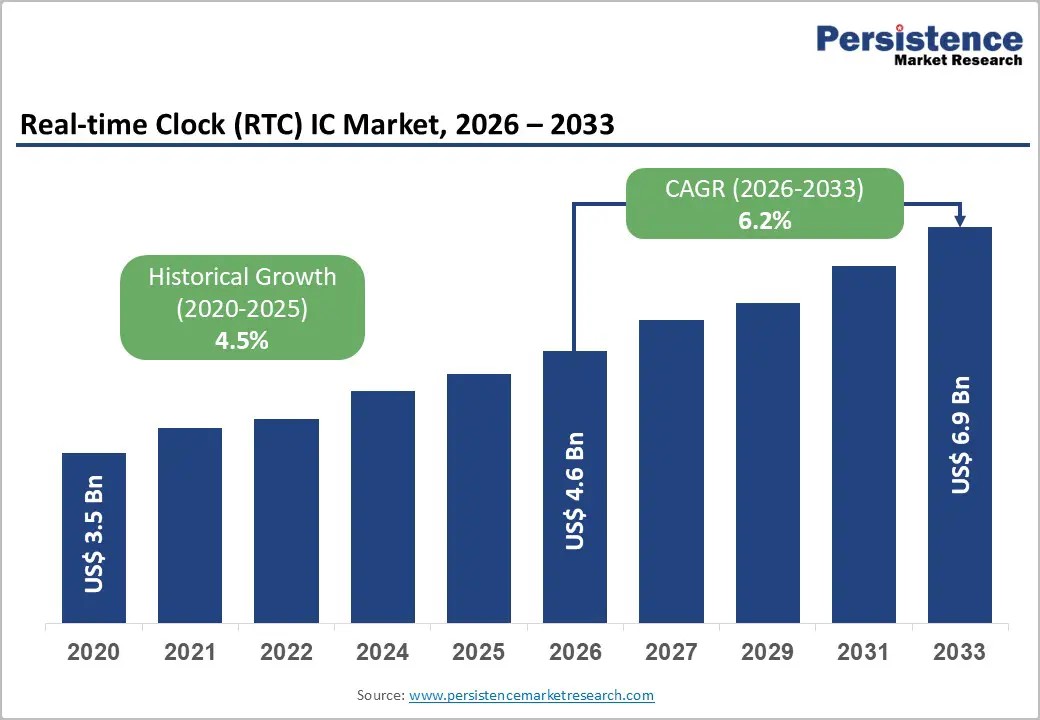
The global real-time clock (RTC) ICs market is projected to grow from US$4.6 billion in 2026 to US$6.9 billion by 2033, at a CAGR of 6.2%. forecast period
BRENTFORD, ENGLAND, UNITED KINGDOM, June 22, 2026 /EINPresswire.com/ -- The global Real-Time Clock (RTC) IC Market is witnessing steady growth, driven by rising demand for precise timekeeping across IoT devices, consumer electronics, automotive, industrial, healthcare, and telecom applications. The market is projected to grow from US$ 4.6 billion in 2026 to US$ 6.9 billion by 2033 at a CAGR of 6.2%. Growth is further supported by the shift toward low-power, compact, and highly integrated semiconductor solutions used in smartphones, wearables, EVs, and connected medical devices. Asia Pacific leads the market with over 40% share, while North America follows with more than 24%, driven by strong innovation and automotive demand.
𝐆𝐞𝐭 𝐚 𝐒𝐚𝐦𝐩𝐥𝐞 𝐏𝐃𝐅 𝐁𝐫𝐨𝐜𝐡𝐮𝐫𝐞 𝐨𝐟 𝐭𝐡𝐞 𝐑𝐞𝐩𝐨𝐫𝐭: https://www.persistencemarketresearch.com/samples/36601
Market Segmentation Analysis
The RTC IC market is segmented based on product type, interface type, mounting type, and application. By product type, Standalone RTC ICs dominate the market, holding more than 60% share in 2026 due to their reliability, dedicated timekeeping functionality, and widespread use in consumer electronics, industrial systems, and embedded applications. These ICs are widely preferred for battery-powered devices where ultra-low power consumption and consistent performance are essential. On the other hand, integrated RTC ICs are emerging as the fastest-growing segment, driven by the increasing need for compact and multifunctional chipsets in IoT devices, automotive electronics, and wearables.
By interface type, I2C dominates the market with over 65% share, primarily due to its simplicity, low pin count, and compatibility with a wide range of microcontrollers. It remains the preferred communication protocol in embedded systems and consumer electronics. However, SPI-based RTC ICs are gaining traction in high-performance applications requiring faster and full-duplex communication, particularly in industrial automation and automotive infotainment systems.
In terms of mounting type, surface-mount technology (SMT) leads the market with over 75% share, driven by miniaturization trends and mass production of compact electronic devices. Through-hole mounting, although smaller in share, continues to grow in applications requiring mechanical strength and durability in harsh environments such as aerospace and industrial systems.
From an application standpoint, consumer electronics hold the largest share (35%+), driven by smartphones, laptops, and wearables. Meanwhile, the automotive segment is the fastest-growing, fueled by EV adoption, ADAS integration, telematics systems, and increasing demand for synchronized electronic control units.
Regional Insights
Asia Pacific dominates the RTC IC market, accounting for over 40% share in 2026, driven by strong semiconductor manufacturing bases in China, Japan, South Korea, and Taiwan. The region benefits from large-scale consumer electronics production, rapid IoT deployment, and government-backed semiconductor initiatives. Countries like India are also emerging as high-growth markets due to digital transformation policies, smart city development, and expanding electronics manufacturing capabilities.
North America holds more than 24% share, supported by advanced semiconductor ecosystems, strong automotive innovation, and robust demand from defense and telecom industries. Government initiatives such as the CHIPS Act are significantly boosting domestic semiconductor production and strengthening supply chain resilience.
Europe remains a key market, led by Germany, France, and the UK. The region benefits from strong automotive manufacturing demand, especially from EV and luxury vehicle segments. Regulatory frameworks such as Industry 4.0 and the EU Chips Act are further accelerating adoption of advanced RTC ICs in industrial automation and automotive electronics.
𝐃𝐨 𝐘𝐨𝐮 𝐇𝐚𝐯𝐞 𝐀𝐧𝐲 𝐐𝐮𝐞𝐫𝐲 𝐎𝐫 𝐒𝐩𝐞𝐜𝐢𝐟𝐢𝐜 𝐑𝐞𝐪𝐮𝐢𝐫𝐞𝐦𝐞𝐧𝐭? 𝐑𝐞𝐪𝐮𝐞𝐬𝐭 𝐂𝐮𝐬𝐭𝐨𝐦𝐢𝐳𝐚𝐭𝐢𝐨𝐧 𝐨𝐟 𝐑𝐞𝐩𝐨𝐫𝐭: https://www.persistencemarketresearch.com/request-customization/36601
Market Drivers
One of the primary growth drivers for the RTC IC market is the rising demand for ultra-low-power timing solutions in IoT and portable devices. RTC ICs are embedded in over 80% of smartphones, wearables, and portable healthcare devices, enabling continuous timekeeping even during power loss. With billions of IoT devices expected globally, the demand for energy-efficient timing components is increasing significantly.
Another major driver is the rapid electrification of the automotive sector and expansion of ADAS systems. Modern vehicles rely heavily on RTC ICs for infotainment synchronization, telematics, navigation, and safety applications. As EV adoption and autonomous driving technologies expand, accurate and reliable timekeeping becomes essential for system coordination and regulatory compliance.
Market Restraints
Despite strong growth potential, the market faces constraints due to the integration of RTC functionality into MCUs and SoCs, which reduces demand for discrete RTC ICs. Many modern embedded systems now include built-in RTC modules, limiting standalone IC adoption in cost-sensitive applications.
Another key challenge is the accuracy limitations of quartz-based oscillators, which are widely used in traditional RTC ICs. Temperature variations and aging can cause frequency drift, making them unsuitable for high-precision applications such as industrial automation, aerospace, and smart grid systems, where more expensive alternatives like MEMS-based timing solutions are required.
Market Opportunities
A major opportunity lies in the adoption of MEMS-based and silicon timing technologies. These next-generation RTC solutions offer superior thermal stability, smaller form factors, and higher reliability compared to quartz-based designs. Companies investing in MEMS timing solutions are well-positioned to serve emerging markets such as AI data centers, 5G infrastructure, and edge computing systems.
Another significant opportunity is the expansion of smart grid and EV charging infrastructure. RTC ICs play a critical role in EV chargers, smart meters, and energy management systems by enabling time-of-use billing, load balancing, and grid synchronization. As global energy systems modernize, demand for reliable timing components is expected to increase substantially.
𝐁𝐮𝐲 𝐍𝐨𝐰 𝐭𝐡𝐞 𝐃𝐞𝐭𝐚𝐢𝐥𝐞𝐝 𝐑𝐞𝐩𝐨𝐫𝐭: https://www.persistencemarketresearch.com/checkout/36601
Company Insights
The key players operating in the Real-Time Clock (RTC) IC Market include:
• Texas Instruments
• STMicroelectronics
• Microchip Technology
• Analog Devices
• NXP Semiconductors
• Seiko Epson Corporation
• Renesas Electronics
• ROHM Semiconductor
• ABLIC Inc.
• Ricoh Electronic Devices
• Diodes Incorporated
• Silicon Laboratories
Conclusion
The RTC IC market is growing steadily, driven by IoT expansion, automotive electrification, and smart device adoption. While SoC integration poses challenges, demand for ultra-low-power and reliable timing solutions continues to support growth. Asia Pacific leads production, while North America drives innovation. Emerging opportunities in MEMS timing, EV infrastructure, and industrial automation are shaping strong long-term market expansion.
Related Reports:
Pooja Gawai
Persistence Market Research
+1 646-878-6329
email us here
Visit us on social media:
LinkedIn
Instagram
Facebook
YouTube
X
Legal Disclaimer:
EIN Presswire provides this news content "as is" without warranty of any kind. We do not accept any responsibility or liability for the accuracy, content, images, videos, licenses, completeness, legality, or reliability of the information contained in this article. If you have any complaints or copyright issues related to this article, kindly contact the author above.
